
The Real Journey of Cross-Border Orthopedic Surgery
A Patient-Centered View of Global Care Pathways
Cross-border medical care is often described in simplified terms: a patient travels abroad, undergoes surgery, and returns home. In reality, this description misses the core complexity of the process. Orthopedic surgery—especially procedures involving the spine, hip, or knee—is not a single event, but a multi-stage journey shaped by uncertainty, decision-making, risk, and long-term outcomes.
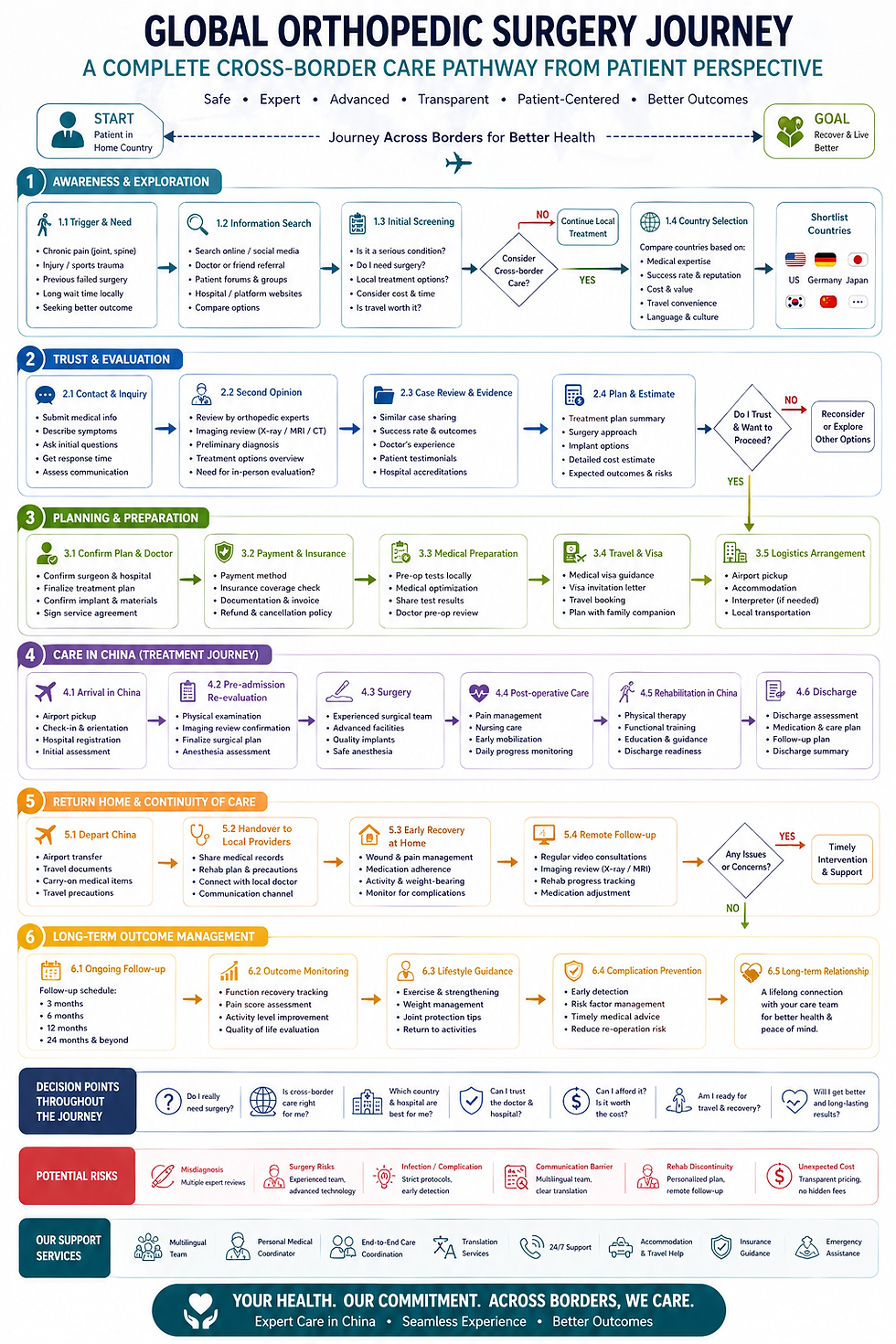
The infographic presented here attempts to map that journey from the patient’s perspective. Rather than focusing on institutional workflows, it reconstructs the full pathway as experienced by individuals navigating pain, information gaps, and cross-border systems.
1. The Journey Does Not Start with Healthcare — It Starts with a Problem
For most patients, the process begins long before any consultation.
Chronic pain, reduced mobility, sports injuries, or failed prior treatments gradually push individuals toward seeking solutions. In many cases, the trigger is not urgency but accumulation—pain that persists, worsens, or begins to affect quality of life.
At this stage, patients are not yet “medical consumers.” They are problem-solvers. The key question is not “Which hospital?” but:
Is this condition serious?
Do I need surgery at all?
Can this be treated locally?
This distinction matters, because it defines everything that follows. Journey of Cross-Border Orthopedic Surgery is really important to all the roles in this market.
2. Exploration:Journey of Cross-Border Orthopedic Surgery is A Global Search Without a Clear Map
Once patients begin exploring options, they enter an unstructured information space.
They may consult:
Search engines and video platforms
Local physicians
Patient communities
Hospital websites or intermediaries
The result is often fragmented. Information is abundant but not easily comparable. Patients are forced to evaluate different countries—such as the United States, Germany, Japan, Korea, and increasingly China—based on incomplete criteria:
Medical expertise
Surgical outcomes
Cost
Waiting time
Language and accessibility
At this point, the process becomes less about medicine and more about navigation.
3. Trust Is the Central Bottleneck
Cross-border care introduces a fundamental challenge: trust transfer.
Patients must shift trust from a familiar local system to an unfamiliar foreign one. This is not trivial. It involves multiple layers:
Trust in diagnosis
Trust in the surgeon
Trust in the hospital system
Trust in communication
Mechanisms such as second opinions, multidisciplinary reviews (MDT), and case-based evidence play a critical role here. Notably, patients tend to trust individual physicians more than institutions. Reputation, experience, and clarity of communication often outweigh branding.
Without trust, the journey stops—regardless of clinical quality. Trust is the base of this service, so we need to get things done to make sure the Journey of Cross-Border Orthopedic Surgery make sense to all.
4. Medical Decision-Making: Reframing the Problem

A key insight in cross-border orthopedic care is that diagnoses are not always stable.
When imaging (X-ray, MRI, CT) is re-evaluated by another medical team, treatment recommendations may change. In a significant proportion of cases, patients discover that:
Surgery may not be necessary
A different surgical approach is preferred
Risk levels differ from initial expectations
This phase is where clinical reasoning intersects with patient expectations. It is also where uncertainty is highest.
5. The Separation of Medical and Financial Decisions
One of the less discussed aspects of cross-border care is the divergence between medical necessity and financial commitment.
Patients must evaluate:
Total cost (surgery, implants, hospitalization, rehabilitation)
Payment structures (self-pay, insurance, hybrid models)
Legal boundaries and liability
Refund and cancellation policies
Importantly, agreeing on a treatment plan does not automatically lead to execution. Financial feasibility and risk tolerance often determine whether the patient proceeds.
6. Mobility as a Medical Constraint
Travel in orthopedic cases is not just logistics—it is part of the clinical equation.
Patients must consider:
Fitness to fly
Travel timing relative to surgery
Need for companions
Entry requirements (medical visas, documentation)
Poor coordination at this stage can directly affect surgical outcomes. Despite this, mobility is often underestimated in traditional care models.
7. Treatment: The Most Visible, but Not the Only Critical Stage
The surgical phase, while central, is only one component of the journey.
It includes:
Pre-admission reassessment
Surgical execution (team, technique, implants)
Immediate post-operative care
Early rehabilitation
Outcomes are influenced not only by surgical skill, but also by pre-operative planning and post-operative protocols.
8. The Hidden Risk: Continuity Breakdown

Perhaps the most underappreciated challenge emerges after the patient returns home.
Common issues include:
Local physicians unwilling or unable to follow foreign treatment plans
Discontinuity in rehabilitation
Delayed detection of complications
Communication barriers
This “continuity gap” is where many cross-border models fail. It is also where patient outcomes are most vulnerable.
9. From Surgery to System: Long-Term Outcome Management
Orthopedic surgery is rarely the end of the story.
Patients require:
Scheduled follow-ups (3, 6, 12, 24 months)
Functional recovery tracking
Imaging reviews
Lifestyle and rehabilitation guidance
The shift here is conceptual: from episodic treatment to continuous management. The goal is not only recovery, but sustained improvement in mobility and quality of life.
10. Decision Points and Risk Awareness

Throughout the journey, patients repeatedly face critical decisions:
Do I need surgery?
Should I stay local or go abroad?
Which country and provider are best?
Can I trust this system?
Is the cost justified?
What happens if something goes wrong?
At the same time, risks are present at every stage:
Misdiagnosis
Surgical complications
Infection
Communication errors
Rehabilitation discontinuity
Unexpected costs
A transparent system does not eliminate these risks—it makes them visible and manageable.
11. Beyond a Flowchart: A System-Level Perspective
The infographic is not merely a process diagram. It represents a shift in how cross-border healthcare is understood.
Instead of viewing medical travel as a transaction, it frames it as a system:
A sequence of decisions
A transfer of trust
A coordination of multiple environments
A long-term health trajectory
For providers, this implies that delivering value requires more than surgical excellence. It requires integration across the entire pathway.
For patients, it clarifies that outcomes depend not only on where surgery happens, but on how the entire journey is managed.
Conclusion

Cross-border orthopedic surgery is often simplified in public narratives, but the reality is far more complex. It is a layered process that combines clinical judgment, personal decision-making, logistical coordination, and long-term follow-up.
Journey of Cross-Border Orthopedic Surgery is clear, but the supporting process are new to the market.
By mapping this journey in full—from the first moment of pain to long-term recovery—the infographic offers a more realistic view of global healthcare in practice.
Ultimately, the question is not whether patients can access care across borders. It is whether the system surrounding that care is capable of supporting them at every step.


Comments