
The Future of Medical Tourism Is Not Medical Tourism but Health Navigation
- Jul 5
- 3 min read

Why AI Will Transform Cross-Border Healthcare into Global Health Navigation
For more than two decades, the international medical travel industry has followed a familiar model.
Patients travel because another country offers better expertise, lower costs, shorter waiting times, or access to treatments unavailable at home.
Hospitals compete for international patients.
Medical travel agencies connect patients with providers.
The industry focuses on logistics—appointments, visas, interpreters, transportation, accommodation, and treatment coordination.
This model has created significant value, but it was built for a world where medical knowledge was difficult to access.
That world is beginning to change.
Recent advances in artificial intelligence suggest that the next transformation in cross-border healthcare will not come from faster transportation or larger hospital networks.
It will come from better decision-making.
The Next Question Is Not “Where Should I Go?”
Historically, international patients asked questions like:
Which country has the best hospital?
Which surgeon has the most experience?
How much does treatment cost?

Increasingly, patients are asking a different question:
What is actually the best option for me?
The answer is rarely a country.
It is a decision.
One patient may benefit from treatment close to home.
Another may require an international second opinion.
A third may not need intervention at all.
The challenge is no longer finding healthcare.
The challenge is choosing the right healthcare.
AI Changes the First Step of the Patient Journey
For years, the first step in medical tourism was search.
Patients searched Google.
They watched videos.
They joined online communities.
They contacted agencies.
Artificial intelligence is changing this behavior.
Instead of searching for hospitals, patients are beginning to ask AI systems questions such as:
“Should I seek treatment overseas?”
“Which country has the strongest expertise for my condition?”
“Is surgery really necessary?”
“Should I obtain a second opinion first?”
This represents a profound shift.
The first interaction is no longer between a patient and a hospital.
It is increasingly between a patient and an intelligent decision-support system.
The Value Moves Upstream
As AI becomes more capable of organizing medical knowledge and comparing treatment options, competitive advantage begins to shift.
Healthcare organizations will no longer compete solely on clinical capability.
They will increasingly compete on helping patients make better decisions.
That means creating value before treatment even begins.
Helping patients understand risks.
Helping families compare options.
Helping people determine whether international care is necessary at all.
The future belongs not only to providers of healthcare, but to providers of healthcare guidance.
Medical Tourism Becomes Health Navigation
This changes the definition of the industry itself.
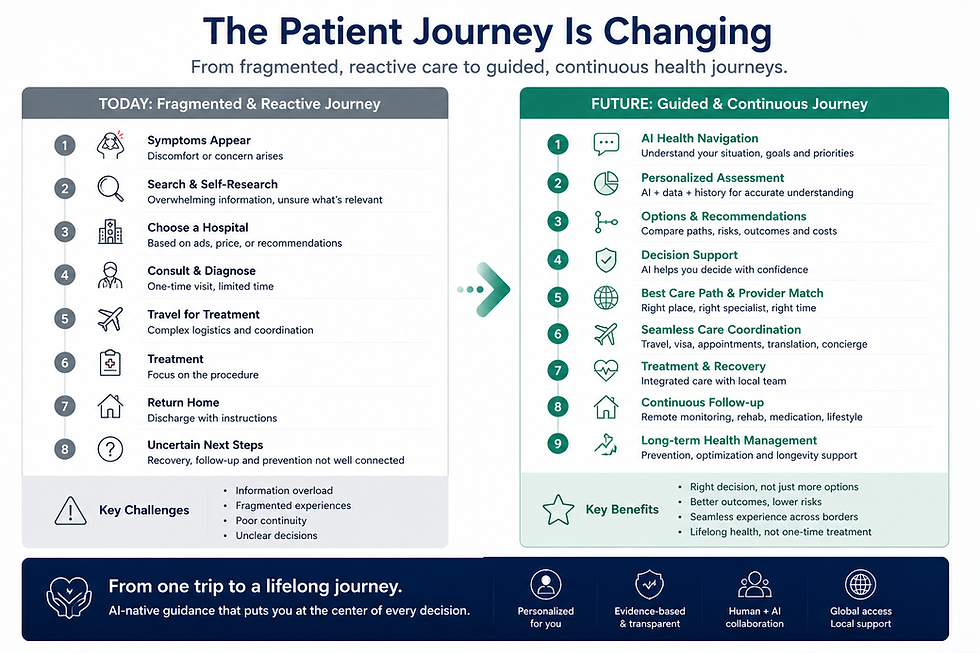
Medical tourism has traditionally focused on one event:
A patient travels.
Receives treatment.
Returns home.
Future healthcare journeys will look very different.
A patient may receive screening in one country.
Seek a second opinion in another.
Undergo treatment elsewhere.
Recover at home.
Continue long-term monitoring through connected devices and AI-supported care.
Healthcare becomes continuous rather than episodic.
Cross-border care becomes one component of lifelong health management rather than an isolated transaction.
From Brokers to Navigators
This evolution also changes the role of organizations serving international patients.
The traditional medical facilitator connects patients with hospitals.
The next generation of organizations will help patients navigate complex decisions throughout their entire healthcare journey.
Their responsibilities extend far beyond referrals.
They include:
interpreting medical information
organizing clinical records
coordinating second opinions
matching patients with appropriate expertise
supporting recovery
maintaining continuity across countries
integrating long-term health management
Navigation replaces brokerage.
Continuity replaces transactions.
Relationships replace referrals.
A New Competitive Landscape
This transformation will also reshape competition.
Hospitals will continue to matter.
Clinical excellence will always matter.
But patients will increasingly expect something more.
They will expect confidence before commitment.
The organizations that succeed will not simply answer the question:
“Where should I go?”
They will answer a much more important one:
“What should I do next?”

Looking Forward of Health Navigation
Artificial intelligence will not eliminate the need for physicians.
Nor will it eliminate the importance of outstanding hospitals.
Instead, it is likely to redefine where value is created.
For international healthcare, that value increasingly lies in helping patients make better decisions before, during, and after treatment.
Medical tourism was built around destinations.
The future will be built around journeys.
And the organizations that help patients navigate those journeys may define the next generation of global healthcare.
NEXA Perspective
At NEXA Longevity, we believe the future of cross-border healthcare is not simply connecting patients with hospitals.
It is building an AI-native Global Health Navigation platform that helps individuals and families make informed decisions across prevention, diagnosis, treatment, recovery, and long-term health management.
The future is not about traveling further for healthcare.
It is about navigating healthcare more intelligently.



Comments