
China’s Healthcare System Is Changing Faster Than Many People Realize
- May 17
- 3 min read
Many international patients still do not consider China when searching for orthopedic surgery or rehabilitation care.
Crowded hospitals.Low-cost manufacturing logic.Fast, but not necessarily “world-class.”Good for local patients maybe — but not somewhere international patients would seriously consider.

That picture is starting to become outdated.
Not everywhere.Not uniformly.But enough that people in global healthcare are beginning to quietly pay attention.
Especially in areas like:
Orthopedics
Rehabilitation
Sports medicine
Minimally invasive surgery
Recovery-focused care
Some Chinese medical teams are becoming genuinely competitive on a global level.
And interestingly, this is not happening because China “copied the West.”
A lot of it comes down to something much simpler:
Scale changes capability
When a surgical team performs extremely high procedure volumes year after year, things start evolving differently.
Not just the surgeon.
The entire surrounding system changes.
Workflows become tighter.Recovery coordination becomes faster.Teams become more synchronized.Operational friction gets reduced.Iteration cycles become shorter.
Eventually, the system itself starts producing different kinds of outcomes.
This is something many people outside China still underestimate.
Because globally, healthcare conversations often focus heavily on reputation.
But inside real clinical environments, repetition and operational density matter a lot.
A team doing thousands of similar procedures every year accumulates a very different kind of experience compared to a system operating at much smaller scale.
That does not automatically make everything better.
But it absolutely changes capability development speed.
The Bigger Shift Is Not About “Cheap Healthcare”

I think this is where many international conversations about China become too simplistic.
People assume the attraction is mainly price.
But increasingly, the more important factor is capability concentration.
Patients today are becoming far more global in how they think.
They are asking questions like:
Who actually does the highest volume of this procedure?
Which recovery systems are more mature?
Which teams are operationally efficient?
Where can I realistically recover faster?
Which country gives me the best overall capability fit?
That is a very different mindset from traditional medical tourism.
The future may not simply be:“Go to the most famous country.”
It may become:“Find the system most optimized for your specific problem.”
And in some specialties, parts of China are starting to enter that conversation.
Recovery Is Becoming More Important Than People Think
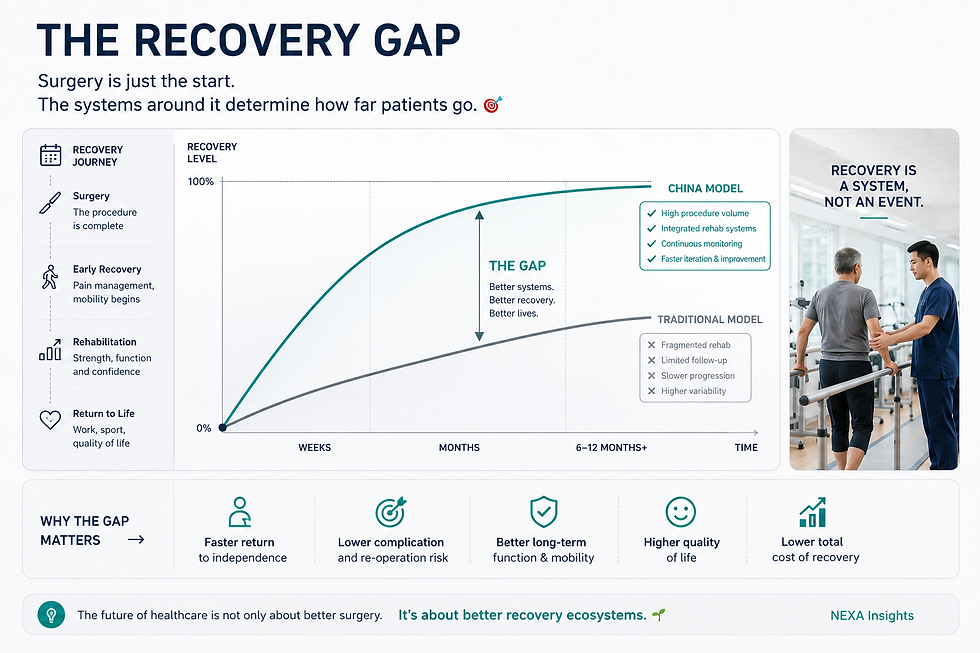
One thing I’ve noticed repeatedly is that many patients still focus almost entirely on the surgery itself.
But long-term outcomes are often heavily shaped by what happens after surgery.
Recovery quality.Rehabilitation consistency.Follow-up coordination.Family support.Lifestyle adaptation.Physical therapy pacing.Mental recovery.
These things matter enormously.
And interestingly, China’s healthcare environment has certain structural characteristics that may create advantages in recovery-intensive specialties:
Dense hospital ecosystems
Large rehabilitation networks
Faster scheduling capacity
High practitioner availability
Strong family caregiving culture
Operational responsiveness
Again, this does not mean every hospital is exceptional.
It means the environment allows certain teams to build highly optimized recovery systems at scale.
That distinction matters.
AI Will Probably Accelerate This Transition
Another major shift happening quietly in the background is AI-native healthcare coordination.
Modern healthcare systems are becoming too fragmented and too complex for most patients to navigate alone.
Especially international patients.
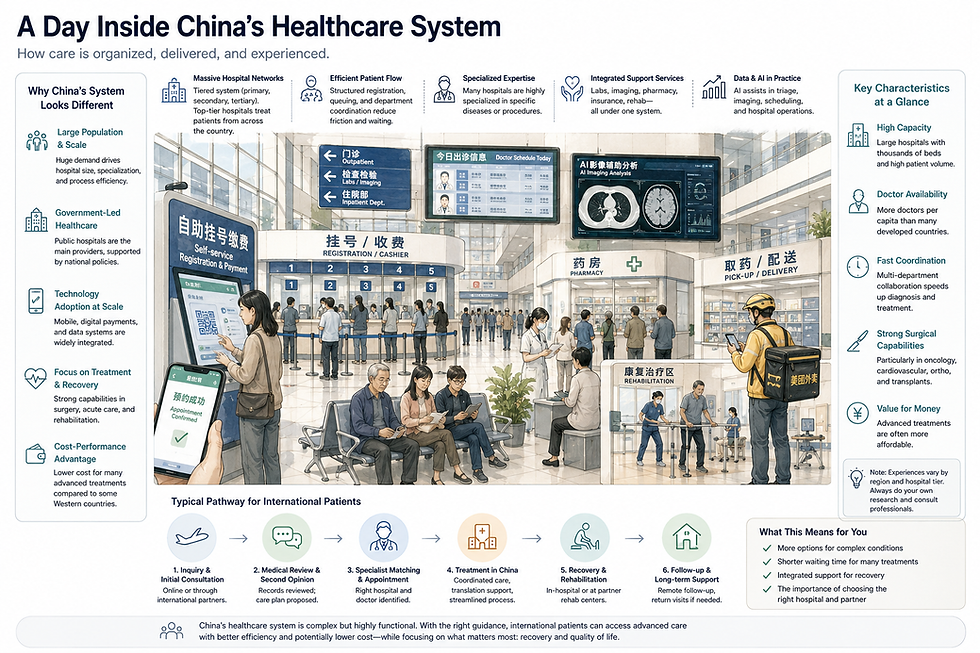
Most people are not actually equipped to compare:
procedures
surgeons
recovery pathways
healthcare systems
long-term outcomes
rehabilitation models
cross-border logistics
This is where healthcare navigation becomes increasingly important.
At NEXA Longevity, we spend a lot of time thinking about this intersection between:
Global patient navigation
China’s emerging medical capabilities
Recovery systems
AI-native coordination
Long-term healthspan
Personally, I increasingly feel the future is not just about “medical tourism.”
That phrase already feels too old.
The real shift is toward:
intelligent healthcare navigation.
Helping people understand:
capability fit
tradeoffs
timing
recovery reality
long-term quality of life
AI is not replacing doctors.
But AI may become increasingly important in helping patients navigate complexity.
And healthcare globally is becoming more complex every year.
China Still Has Challenges
Of course, capability alone is not enough.
International trust also depends on things like:
communication
transparency
coordination
patient experience
global accessibility
long-term follow-up
This is still an evolving process.
China’s healthcare system is extremely strong in some areas.Still immature in others.Highly uneven in certain aspects.
But that is also true for many healthcare systems globally.
The important point is this:
The old assumption that China only competes on cost is becoming increasingly inaccurate.
In some specialist areas, the conversation is starting to shift toward capability.
And once that happens, global attention usually follows.
The Future of Healthcare May Become More Distributed
For decades, global healthcare has been psychologically centered around a small number of countries.
But I don’t think the future will look exactly like that.

Different countries may become globally recognized for different capabilities.
One region for oncology.Another for rehabilitation.Another for robotics.Another for longevity-focused recovery systems.
Healthcare may become increasingly distributed and capability-driven.
And in some of those future maps, China will probably play a much larger role than many people currently expect.
Not because of headlines.
But because capability compounds quietly over time.


Comments